ÖZYEĞİN UNIVERSITY / SURGICAL ROBOTICS

Ozyegin University
Autonomous Suturing
Project.

Learning precise movements.
Advancing autonomous surgical skills.

Explore our research ↗
A COLLABORATION BETWEEN

Cognitive Robotics Lab + Robotics Lab

PRECISION THROUGH LEARNING

Teaching robots
the art of suturing.

We investigate how robots can learn the precise, coordinated movements needed for autonomous surgical tasks.

Our work brings together learning from demonstration, reinforcement learning, and simulation: from bimanual needle handover to the modeling of soft tissue and surgical thread.

Bimanual manipulationRobot learningSoft tissue simulation
THE SIMULATION ENVIRONMENT 01
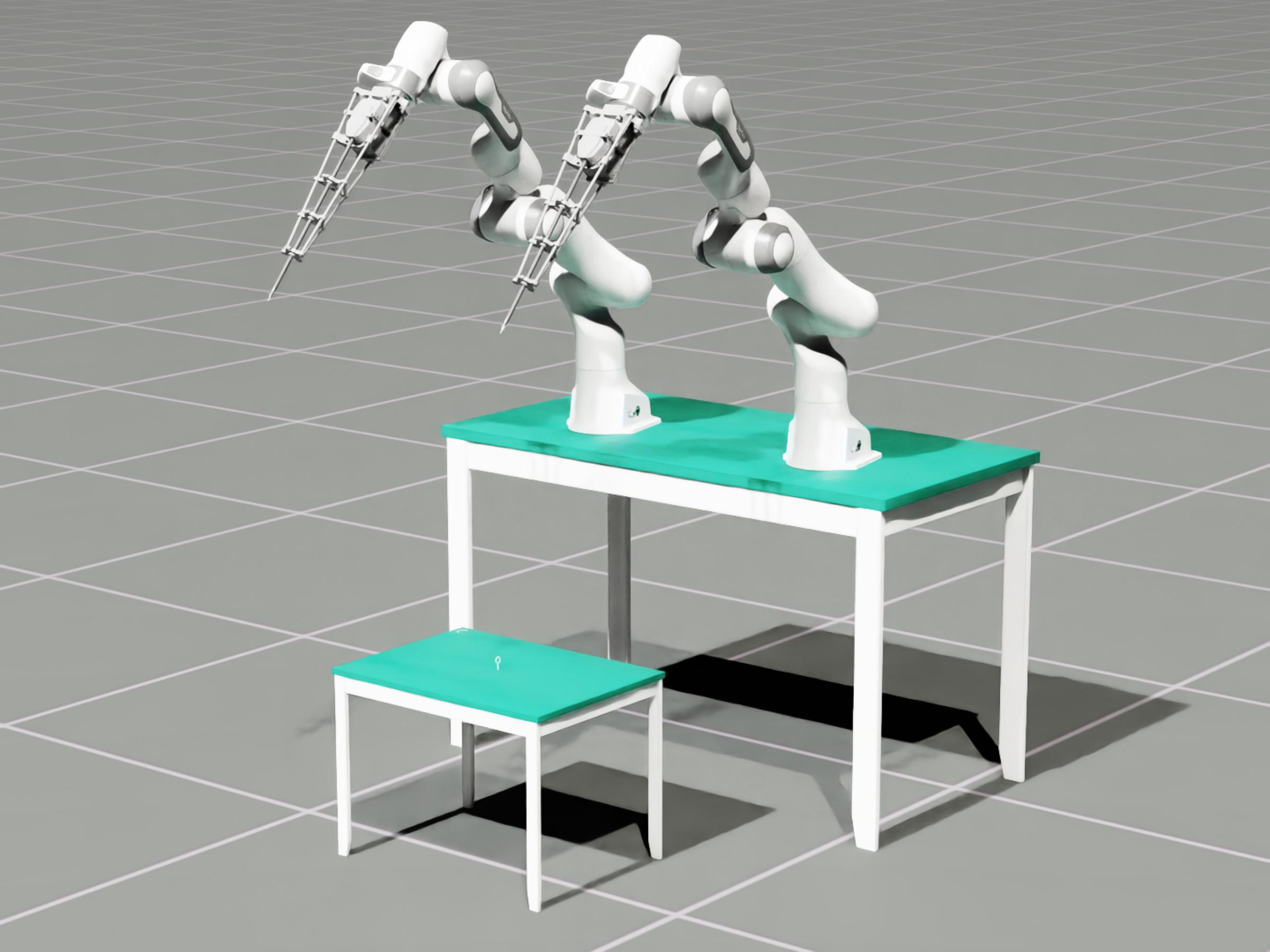
Dual-arm surgical robotics simulation with two manipulators mounted over an operating table
Dual-arm simulation setup NVIDIA Isaac Sim
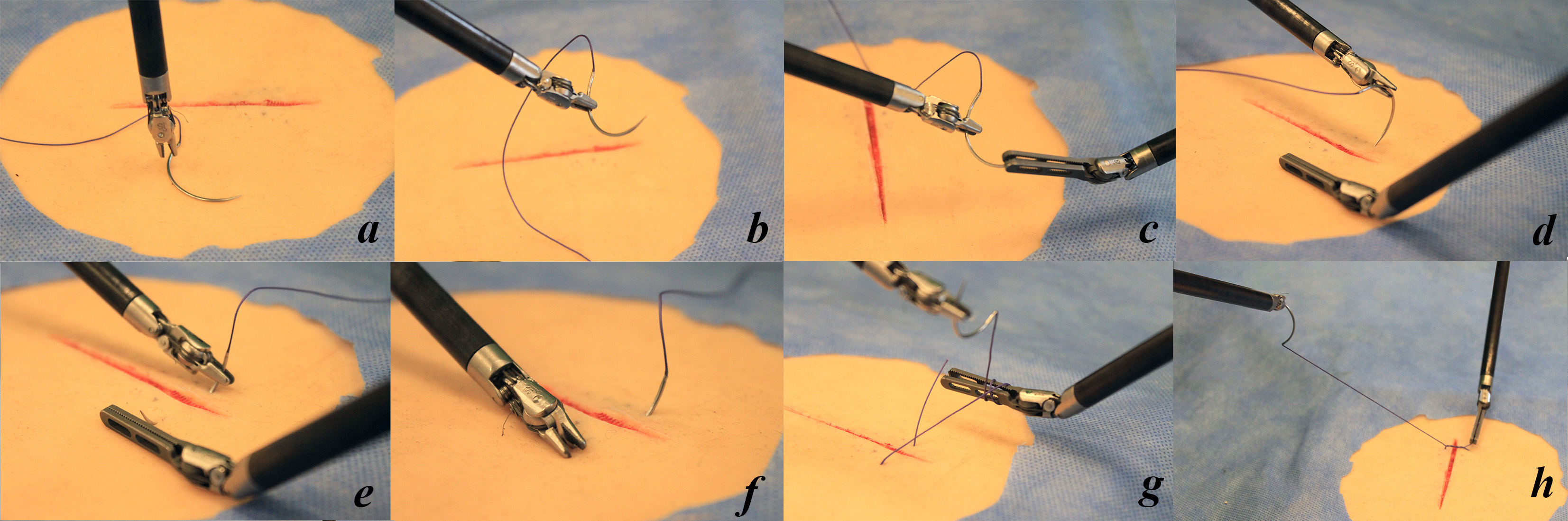
Eight sequential views of robotic instruments manipulating a curved surgical needle
Surgical needle manipulation sequence · project report.

Papers & Posters
of The Project.

Our work on learning, adaptation,
and autonomous surgical manipulation.

012026
Bimanual manipulationTO APPEAR · PROJECT NOTES

Learning Bimanual Surgical Needle Handover via Context-Based Echo State Networks in Isaac Sim

Engin Kuser†, Zahra Koulaeizadeh†, Ozkan Bebek, Erhan Oztop

International Conference on Control, Automation, and Systems (ICCAS) · 2026

† Equal contribution · Engin Kuser: corresponding author

Read abstract +

Bimanual object handover is a fundamental capability for collaborative robotic manipulation, particularly in precision-demanding surgical subtasks. This paper investigates the application of Context-Based Echo State Networks (CESNs) as a computationally efficient Learning from Demonstration (LfD) mechanism for autonomous bimanual needle handover. We develop a dual-arm simulation environment in NVIDIA Isaac Sim featuring two Franka Panda manipulators equipped with patient-side manipulator (PSM) tools. Demonstration trajectories are generated programmatically utilizing the cuMotion planner across four varying spatial needle initializations. Addressing high-dimensional control, the CESN architecture receives external task contexts and robot joint feedback to directly predict continuous 11-degree-of-freedom (DoF) joint-position commands for closed-loop execution. We evaluate the model’s performance through offline joint trajectory reconstruction and online simulation rollouts. The results indicate that CESNs can accurately reproduce context dependent bimanual trajectories with low computational overhead, achieving millimeter-level precision and offering a lightweight alternative to high-capacity deep learning models for encoding structured manipulation subtasks.
BibTeX
022026
Robot learningTO APPEAR · PROJECT NOTES

Reinforcement-driven modulation of fixed reservoir dynamics for efficient and adaptive control

Zahra Koulaeizadeh, Minoru Asada, Erhan Oztop

Neurocomputing · 2026

Read abstract +

Learning from Demonstration (LfD) enables policy acquisition from expert trajectories; however, adapting those skills to novel goals or constraints without specifying exact trajectories remains difficult. Reinforcement Learning (RL) can extend LfD in such cases, but conventional LfD–RL approaches are computationally costly: they involve high-dimensional parameter optimization and often require retraining the original LfD policy network during RL. We introduce the Dynamic Adaptive Reservoir Computing (DARC) model, a two-stage learning framework that avoids these limitations. In the first stage, a Context-based Echo State Network (CESN) is trained from demonstrations to capture the base LfD behavior. In the second stage, RL modulates the internal reservoir dynamics through low-dimensional context signals, without modifying the learned LfD weights to generate movements that satisfy new goals or constraints. This architecture preserves previously acquired skills while allowing efficient RL-based adaptation. Experiments on reaching with obstacle avoidance show that DARC achieves higher success rates in skill extension and generalization while requiring less computation than a competitive LfD–RL baseline. The proposed framework further maintains its performance advantage under changes in robot morphology and dynamics. In particular, we demonstrate its scalability on a three dimensional pick-and-place task, where a three-dimensional context signal effectively modulates the reservoir dynamics, generating an eight-dimensional joint-and-gripper command. Overall, the results indicate that integrating reservoir-based LfD with reinforcement-driven dynamical modulation provides an efficient and scalable approach for adapting demonstration-learned behaviors to new goals, constraints, and changes in robot morphology and dynamics.

BibTeX

Project Leaders.

Connecting cognitive robotics
with medical robotics.

Erhan Oztop

Cognitive Robotics Lab

Erhan Oztop

Professor · Robotics & AI

Artificial Intelligence and Data Engineering
Özyeğin University

Studies how robots acquire, adapt, and generalize skills through demonstration and reinforcement learning. His research connects cognitive robotics, computational motor control, and bimanual manipulation.

Robot learning · Learning from demonstration · Reservoir computing · Adaptive control

Education & background +

Ph.D., University of Southern California; M.Sc. Computer Engineering and B.Sc. Computer Engineering & Mathematics, Middle East Technical University.

Selected publications +
  1. 2026 · ICCAS · to appear (project notes)Learning Bimanual Surgical Needle Handover via Context-Based Echo State Networks in Isaac Sim

    E. Kuser, Z. Koulaeizadeh, O. Bebek, E. Oztop

  2. 2026 · Neurocomputing · to appear (project notes)Reinforcement-driven modulation of fixed reservoir dynamics for efficient and adaptive control

    Z. Koulaeizadeh, M. Asada, E. Oztop

  3. 2025 · IEEE Robotics and Automation LettersSymbolic Manipulation Planning with Discovered Object and Relational Predicates

    A. Ahmetoglu, E. Oztop, E. Ugur

  4. 2023 · IEEE ICRABimanual Rope Manipulation Skill Synthesis through Context Dependent Correction Policy Learning from Human Demonstration

    B. Akbulut, T. Girgin, A. Mehrabi, M. Asada, E. Ugur, E. Oztop

  5. 2023 · IEEE RO-MANContext Based Echo State Networks for Robot Movement Primitives

    N. Amirshirzad, M. Asada, E. Oztop

  6. 2022 · IEEE CASEAdaptive Shared Control with Human Intention Estimation for Human Agent Collaboration

    N. Amirshirzad, E. Ugur, O. Bebek, E. Oztop

  7. 2019 · IEEE ICARMAdaptive Inverse Kinematics of a 9-DOF Surgical Robot for Effective Manipulation

    B. Sunal, E. Oztop, O. Bebek

Ozkan Bebek

Robotics Lab

Ozkan Bebek

Associate Professor · Principal Investigator

Mechanical Engineering
Özyeğin University

Works on robotics, mechatronics, and control systems for healthcare. His research spans medical robotics, computer-assisted surgery, autonomous surgical systems, and wearable robotics.

Medical robotics · Computer-assisted surgery · Mechatronics · Wearable and legged robotics

Education & background +

Ph.D., Case Western Reserve University; M.Sc., Sabancı University; B.Sc., Middle East Technical University.

Selected publications +
  1. 2022 · IEEE CASEAdaptive Shared Control with Human Intention Estimation for Human Agent Collaboration

    N. Amirshirzad, E. Ugur, O. Bebek, E. Oztop

  2. 2019 · IEEE ICARMAdaptive Inverse Kinematics of a 9-DOF Surgical Robot for Effective Manipulation

    B. Sunal, E. Oztop, O. Bebek

THE RESEARCH TEAM

Researchers.

Building the next steps in autonomous suturing.

Engin Kuşer

Engin Kuşer

Robotics & AI Researcher

Cognitive Robotics Lab

Focuses on bimanual surgical needle handover, deformable soft tissue modeling, and motion planning using NVIDIA Isaac Sim and ROS 2.

Research & background +

B.Sc. Mechanical Engineering · M.Sc. Artificial Intelligence (ongoing)

Surgical robotics · Context-based echo state networks

NVIDIA Isaac Sim / Python / C++

Nezife Havin Yılmaz

Nezife Havin Yılmaz

Robotics & AI Researcher · Student

Cognitive Robotics Lab

Senior Computer Science student specializing in artificial intelligence. Her work focuses on cognitive robotics, cognitive architectures, and deformable thread modeling in NVIDIA Isaac Sim.

Research & background +

B.Sc. Computer Science (ongoing)

Cognitive robotics · Deformable thread simulation

NVIDIA Isaac Sim / Python

Seden Mutaf

Seden Mutaf

Robotics & AI Researcher

Cognitive Robotics Lab

Researches robot learning and Vision-Language-Action models for vision-based robotic manipulation, building on undergraduate work in deep learning, computer vision, and multimodal image matching.

Research & background +

B.Sc. Computer Science · M.Sc. Computer Science (ongoing)

Robot learning · VLA models · Computer vision

Python / C++ / PyTorch / ROS 2 / Gazebo

Zahra Koulaeizadeh

Zahra Koulaeizadeh

Ph.D. Researcher · Robot Learning & AI

Cognitive Robotics Lab

Studies robot skill acquisition, adaptation, and generalization through reinforcement learning and learning from demonstration, with applications in autonomous manipulation and surgical robotics.

Research & background +

M.Sc. Artificial Intelligence, Özyeğin University · B.Sc. Computer Engineering, Urmia University

Reinforcement learning · Learning from demonstration